Seating Chart Tips From Veteran Teachers
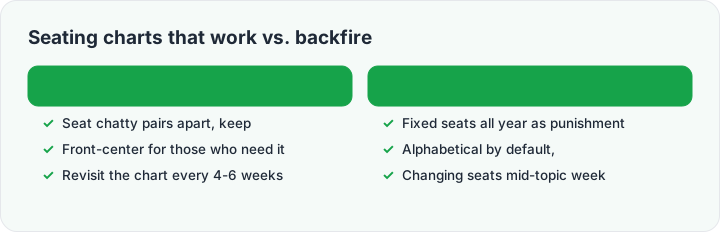
Verdict first: a seating chart is a teaching tool, not a punishment rota. The charts that work place students where the learning support is (front-center for those who need it, chatty pairs split, friends kept visible but not adjacent) and get refreshed every four to six weeks. The charts that backfire treat the seat as a sentence.
What working charts have in common
Three placement principles show up in every chart that lasts. Front-center is a resource: the students who most need proximity to the teacher sit there — not the best behaved. Social geography is deliberate: the two students who ignite each other sit diagonally, friends stay in sight but out of whisper range, and every student has at least one ally in reach — isolation is a behavior problem in waiting. Sightlines are sacred: no seat should require a prayer to see the board.
The refresh rhythm
Charts calcify. A chart that was strategic in September is, by November, just the furniture — and the social dynamics it was built to manage have drifted underneath it. Refresh every four to six weeks: keep what is working (the diagonal separation that silently ended a feud), change what has gone stale. The refresh itself is a tool — a visible reshuffle resets habits the way a fresh random grouping resets group-work dynamics.
What backfires, and why
Seats-as-sentences — parking a chatty student alone at the front for a term — reads as exile, breeds resentment, and quietly teaches the class that seating is surveillance. Alphabetical-by-default ignores everything you know about the humans involved. Mid-topic reshuffles (week three of the coursework unit) burn trust for no gain; change seats at natural boundaries, not mid-fight. And the silent killer: never revisiting the chart at all, letting September's strategy rot into May's furniture.
Where the tools fit
Seating is the long-cycle layer; grouping is the short-cycle one. A seating chart manages the term's social geography; the group generator and name picker manage the lesson's randomness. The veteran pattern is to alternate deliberately: fixed seats for stability, random groups for freshness, and the week-one icebreakers to seed the relationships both layers depend on.