How to Group Students
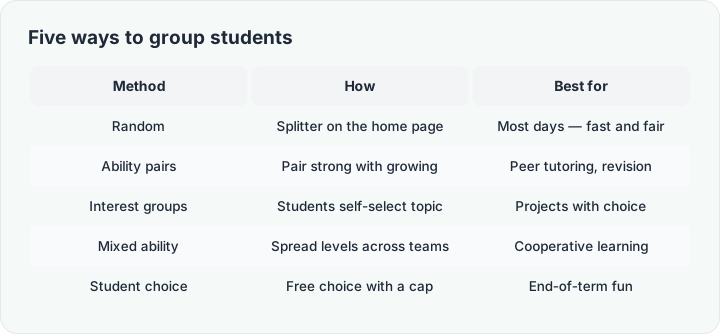
Verdict first: there is no best way to group students — there are five reliable ways, and the skill is matching the method to the moment. Random for speed and fairness, ability pairs for support, interest groups for ownership, mixed-ability teams for cooperative learning, and student choice for the days when goodwill matters more than structure. Here is each one, honestly priced.
1. Random grouping — the default that works
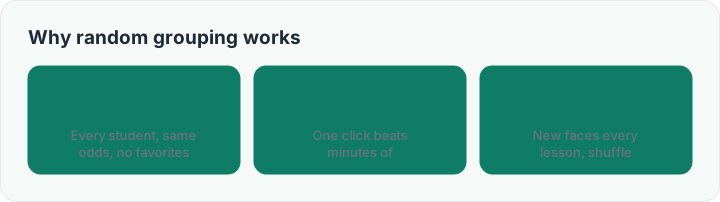
Random is what a group generator automates: no social negotiation, no ability signaling, a fresh mix every time. It wins on most ordinary days because it is fast (one click), fair (identical odds), and self-justifying ("the computer decided" ends appeals). Its cost: sometimes the chemistry is wrong — a group with three students who cannot sit near each other. The professional move is not to abandon randomness but to treat one reshuffle as normal: shuffle again, keep moving.
2. Ability pairs — support with dignity
Pair a stronger student with one who needs scaffolding and the pair often teaches itself: the stronger student consolidates by explaining, the other gets help without raising a hand in front of the class. Two cautions keep it healthy: rotate both roles (explainer today, explainer-ed tomorrow), and never make the pairing pattern so legible that the class can rank itself by reading the room.
3. Interest groups — ownership buys effort
Let students pick the topic — which ecosystem to model, which poet to defend — and motivation arrives pre-installed. The risk is clustering and choice paralysis; the fixes are caps (max five per group) and a visible sorter. Interest groups shine for projects with a genuine menu of options, and fail when all options are really the same.
4. Mixed-ability teams — the cooperative learning standard
Structured cooperative learning (the next guide covers the classic structures) wants each team to carry a range of strengths: a thinker, an organizer, a reporter, a peacekeeper. Build these teams deliberately or split randomly and reshuffle until the spread looks right — either way, the point is complementary teams rather than ranked ones.
5. Student choice — spend it sparingly
Free choice is real motivation and real chaos. It works late in a term when the class has proven it can handle autonomy, with a hard cap per group, and with the understanding that the next grouping is the teacher's again. As a default it collapses into friendship clusters; as an occasional treat it builds trust.