Cooperative Learning Groups That Actually Work
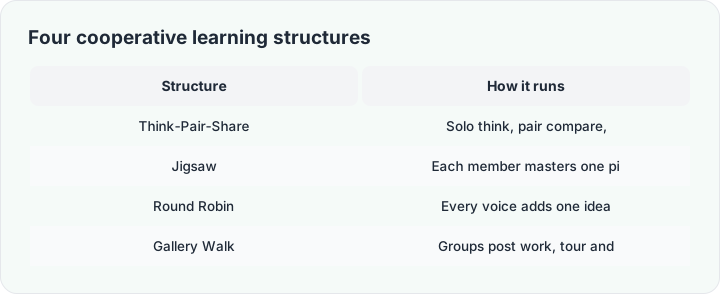
Verdict first: cooperative learning is not students sitting near each other — it is structure that makes every member indispensable. Four structures have decades of classroom evidence behind them: Think-Pair-Share, Jigsaw, Round Robin and Gallery Walk. Each needs a different grouping, and each fails without its structure.
Think-Pair-Share — the smallest unit that works
Thirty seconds of silent thinking, two minutes comparing with a partner, then pairs report. The grouping is pairs (random keeps it honest), and the structure guarantees the two things cold-calling alone cannot: rehearsal before the public moment, and an answer co-owned by two people. It is the highest-value ninety seconds in teaching — cheap enough for every lesson, strong enough to double participation overnight.
Jigsaw — interdependence by design
Each member of a home group masters one piece of the material (expert groups of the same piece confer first), then teaches it back to their home group. The structure makes every student the only source of something the group needs — the anti-freeloader machine. Grouping: home groups of four to five (random or mixed-ability), expert groups by piece. The group generator's shuffle-again feature makes building both sets of groups a ten-second job.
Round Robin — every voice, in turn
Teams answer or add ideas strictly in turn, no pass-outs. It dismantles the dominance of fast voices and makes airtime visible. Grouping is flexible; the structure is the turn order. Use the name picker to choose which team starts, and let the order run from there.
Gallery Walk — movement with a purpose
Groups post their work, then tour the room commenting on others' outputs. The movement resets attention, and reading peers' work is quietly one of the strongest revision experiences available. Grouping: any teams; logistics matter more — space the posters, time each station on a visible countdown.
The common thread: in every structure, the grouping is the cheap part and the structure is the engine. Random teams with a strong structure beat hand-picked teams with none — which is why the generator-plus-structure combo is the highest-leverage habit in the building. Start with one structure, run it until the class knows it cold, and only then add the next; four half-learned structures are worth less than one that runs itself.